Advancing HIV research and equity: Dionna’s unique path in science
In this article, we spoke to Dionna about their scientific journey, which began with a STEM-focused education that nurtured early exposure to advanced research techniques like mass spectrometry. Their career has been dedicated to HIV research, with a focus on improving medication delivery to the brain and addressing systemic inequities impacting marginalized communities. Dionna’s advocacy for representation in STEM and their commitment to mentorship have shaped an impactful legacy, blending scientific innovation with a human-centered approach. Their story highlights the power of curiosity, resilience and collaboration in driving meaningful change.
Find more career development resources from Black scientists here.
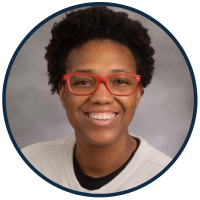 Dionna Williams
Associate Professor
Emory University (GA, USA)
Dionna is currently an Associate Professor of pharmacology and chemical biology at Emory University, where they run the Williams Lab. Their research interests are in the neuropathogenesis of HIV, regulatory mechanisms of neuroimmune signaling, drug delivery into the central nervous system, and immunologic and pharmacologic contributors to health disparities. Dionna received their undergraduate degree in biochemistry from Hofstra University and their PhD from the Albert Einstein College of Medicine (both NY, USA).
A unique start in science
Dionna had an exceptionally unique foundational education. Attending a STEM-focused magnet school that fed into a science high school meant science was embedded into day-to-day life. Alongside English, maths and history classes were engineering, woodwork and marine biology. By the age of 15, they had already earned their boating license — before even stepping into the driving seat of a car. They built fishing rods, designed boat schematics using engineering software, and earned their CPR certification, all before turning 16.
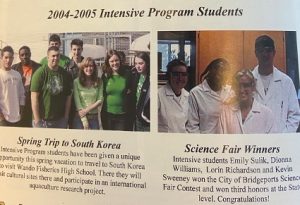
Dionna and their peers pictured during an exchange trip to South Korea (left) and at the school science fair (right).
The school merged students from three or four different cities, bringing together children from all walks of life with different socioeconomic, racial and ethnic backgrounds. For Dionna, this was the first time they encountered peers who, at first glance, seemed to have little in common. Yet a shared interest in science created a sense of unity. In their senior year, Dionna went on their first trip abroad with a foreign exchange program with a school in South Korea. Despite, on the surface, feeling very different from their Korean peers, Dionna found that they had more in common than they thought:
“It opened my perspective on the world, what science could be and helped me to see that we did not speak the same language. We ate very different foods, had very different cultures. But we all had things in common. We liked video games, we played basketball and we liked science.”
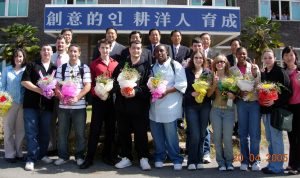
Dionna’s class in South Korea during a foreign exchange program (2005).
By the time Dionna graduated from high school, they had already conducted independent research projects using mass spectrometry, inorganic spectroscopy and UV-VIS spectroscopy. They had been pipetting since the age of 15 and were repeating university-level inorganic chemistry labs before setting foot on a college campus. This strong foundation made the transition to higher scientific education seamless and familiar, and set the stage for a career in science. After all, how many people can say they were doing mass spectrometry at 16?
Finding purpose in HIV research
Dionna’s early exposure to science went on to inform their career trajectory, but it was their desire to work on clinically relevant problems that shaped their research focus. During their PhD, Dionna became captivated by neuro HIV, specifically the neurological dysfunction that can present itself in those living with the virus. As the project took shape, Dionna investigated immune cell trafficking across the blood-brain barrier, a critical area of study given the challenges of delivering HIV medications to the brain.
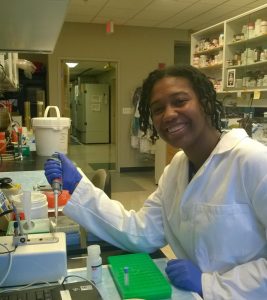
Dionna working in the University lab at Hofstra University.
At Johns Hopkins (MD, USA), during their postdoc, Dionna delved deeper into neuroimmune signaling, investigating how immune cells like astrocytes communicate with microglia in the brain. This work revealed a new signaling pathway, marking a significant milestone in their career. Around this time, Dionna received the Pathway to Independence Award through the National Institute on Drug Abuse, a highly sought-after mentorship program aiding researchers’ transition into tenure-level positions. The award was instrumental in broadening Dionna’s skills in pharmacology and mass spectrometry methodologies, which would later allow them to pursue many different avenues of research. It also gave them choice; instead of having to follow their advisor’s research topics, they had the funding and time to work on projects that interested them. This was also their first opportunity to lead a project independently, an experience that solidified their passion for tackling unanswered questions in HIV research.
At the time, HIV medications were highly effective, but they couldn’t reach every part of the body equally. The brain, protected by the blood-brain barrier, remained a challenging area for treatment. Dionna’s work aimed to address this gap, applying their expertise to improve medication delivery to the brain. But it wasn’t just the science that drew Dionna in — it was the people.
In seminars, Dionna noticed that HIV was often spoken about as a “monolith”, with little attention paid to the individuals affected by the disease. They learned that certain groups, particularly racial and ethnic minorities and LGBTQ communities, were disproportionately impacted due to systemic barriers to care and medication access. Hearing about the affected communities and their stories sparked an interest in the “who?” part of the HIV question, and just like that, Dionna’s research found its path.
Advocating for equity in science
Racial and ethnic minorities have always been central to Dionna’s research into HIV, so when they were approached to be a part of a commentary recognizing the barriers to equitable science, participation was a no-brainer. The publication sought to highlight the limitations that inhibit the progress of Black individuals in STEM, particularly for those with intersectionality; individuals underrepresented by a combination of gender, sexual orientation, disability status and race.
The publication begins with a powerful statement: “We are 52 Black scientists.” This unique collaboration allowed Dionna to, firstly, work alongside other Black scientists on a manuscript, but also to contribute their thoughts and feedback on a seminal article.
“It was a joy to work on this shared document with people who understood what it meant to have a background underrepresented in science and to be specifically Black in science. We all had gone through our training in various places, not seeing many other peers and especially not many other faculty members who had a similar background to ours. It was really rewarding to co-author with these other outstanding, brilliant scientists and give a perspective based on literature and based on lived experience, on barriers to equal access and opportunity for Black scientists.”
This collaboration was a powerful reminder of the importance of representation and the need for improved inclusivity in the scientific community.
Current focuses and day-to-day
With 70+ papers under their belt, Dionna has mastered the art of balancing research, teaching and mentorship. Every day begins with uninterrupted writing time from 9 to 10, dedicated to manuscripts, grant applications or preparing lecture slides. The rest of the day is filled with teaching, mentoring students and attending seminars. Despite their busy schedule, Dionna still finds joy in lab work, often carving out time for experiments.
Currently, Dionna’s lab is focused on improving medication delivery to the brain for HIV treatment. They are also exploring the effects of cannabinoids on HIV-related inflammation and immune response, as well as the neurogenesis in the adult brain. Grants for new projects, including epigenetics, placental and maternal outcomes, and kidney complications resulting from HIV, have expanded their research scope. Dionna attributes this success to creativity, curiosity and strong collaborations.
Mentoring and legacy
Throughout their education and career, Dionna had clear mentors, from their freshman biology teacher, Carla Ebmeyer, and sophomore chemistry teacher, Renee Sanz, all the way up to their postdoc mentor, Namandje Bumpus. These figures not only nurtured Dionna’s scientific curiosity but also instilled a sense of belonging in a field where representation was, and continues to be, scarce.
“I was quite a chatty kid and I got in trouble a lot for talking too much. But I think they saw kind of ‘diamond in the rough’ and really invested in me and made me feel like there was a place for me in science.”
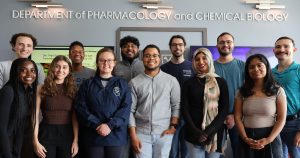
Dionna’s mentoring group at Emory University.
Now, mentorship is central to Dionna’s own career. They view it as a privilege to guide young scientists, helping to navigate the challenges of STEM and build confidence whilst pursuing their interests. One of the most rewarding yet challenging aspects of mentorship, Dionna notes, is passing on their writing skills and approach to scientific storytelling. For Dionna, writing a paper is more than simply presenting data — it’s about crafting a narrative that brings the findings to life. While this process is time-consuming, it’s a skill they are deeply committed to instilling in their students and mentees.
Although Dionna once aspired to become a Department Chair, their focus has now shifted to achieving a balance between leadership, personal well-being and supporting others.
“I still aspire to attain some kind of leadership role, and I do know I’m passionate about mentorship of my trainees. I think it’s a privilege to be able to advocate for others, to support others, to represent them and their interests.”
A testament to the power of curiosity, resilience and mentorship, Dionna’s journey is a shining example of how passion can drive meaningful research. From their unique beginnings in a STEM-focused school to life-changing research in HIV and neuroimmune signaling, Dionna has remained deeply connected to the human impact of their work.
The opinions expressed in this interview are those of the interviewee and do not necessarily reflect the views of Bioanalysis Zone or Taylor & Francis Group.