The science of bioanalytical training

In the winter 2025 column installment, we explored the role of technical training in the bioanalytical lab environment, including the opportunities available to build new competencies and leadership opportunities among your team. I specifically related the impact of working with a technical trainer at the very outset of my first industry bioanalytical role and related how we continued that professional relationship to provide new and continuing opportunities for my team members over time.
For this quarter’s column, I wanted to flip the script to an interview format, to share with our readership the practicalities and potential of bioanalytical technical training from the trainer’s point of view. Please welcome Michael Montague, who brings a wealth of practical experience in GLP, GCLP, and GMP environments, not only implementing training directly but also training others to become effective trainers themselves. In this interview, he will be sharing his overall philosophy on technical training as well as specific tips and tricks that you can implement in your own laboratory.
 Catherine Vrentas
Bioanalytical SME
Prior to her current role, Cathy was most recently a Life Sciences Lead Associate at Booz Allen Hamilton (VA, USA), where she supported a large portfolio of federally-funded, preclinical through clinical programs in the CGT space and specializes in clinical trials and bioanalysis. Prior to this role, she was a Principal Scientist and managed a team of ~20 scientists at Thermo Fisher Scientific (VA, USA). In this role, she led the development and validation of 100+ assays to assess samples for preclinical programs and clinical trials for pharma and biotech, including work on multiple first-in-human trials for rare diseases and gene therapies. Cathy has experience in regulated immunoassays and cell-based assays for PK, ADA, NAb and biomarker applications, as well as enzymatic assays, oligonucleotide assessments, COVID-19 assays and tissue-based assessments.
Cathy received her BSc in Biochemistry and Molecular Biology from Penn State (PA, USA), a PhD in Cellular and Molecular Biology from the University of Wisconsin-Madison (WA, USA), an MBA from Longwood University (VA, USA), and an MPH in public health practice from Des Moines University (IA, USA). She has mentored over 60 scientists, students and summer interns in laboratory methods over her career and has volunteered for diverse nonprofits, including the foster care system, dementia education, prison education, youth science outreach, public health, oyster restoration and health advocacy.
 Michael Montague
Director of Training
Michael is a Learning & Development leader with more than 15 years of experience across bioanalytical science, regulated laboratory operations, and technical workforce development. His career began in research and early‑stage bioanalytical work at Abbott Laboratories (IL, USA) and Medical College of Virginia (VA, USA), where he supported immunotoxicology studies, analytical testing, and GLP/GMP‑aligned laboratory practices. He later joined PPD, now part of Thermo Fisher Scientific (MA, USA), where he advanced from scientist to Principal Learning & Development Manager, supporting global teams across regulated bioanalysis and complex GxP environments.
Over the past several years, Michael has transitioned into senior training leadership within the pharmaceutical and advanced manufacturing sector, currently directing technical training strategy for a highly regulated API and manufacturing organization. In this role, he oversees the development of competency frameworks, technical curricula and training systems that support operational readiness, method transfer and quality‑driven execution across scientific, quality and production teams. His work blends scientific rigor with human performance principles, with a focus on reducing variability, strengthening data integrity, and building sustainable technical capability across the full assay lifecycle.
Michael holds a BS in Biology from Virginia Commonwealth University (VA, USA). Throughout his career, he has mentored scientists, guided early‑career professionals, and shaped training programs that elevate technical proficiency and quality culture across the bioanalytical, pharmaceutical and advanced manufacturing fields.
Cathy: Michael, thank you for joining us for this special guest interview! Could you get us started by sharing about your background and what motivated you to develop your career in the field of technical training?
Michael: 10 years ago, as a Career Scientist, I left my job!!! Well…not really.
What I actually did was stumble — completely by accident — into a passion for training/learning and development.
This occurred when I accepted an opportunity to lead a newly formed department consisting of a large group of new chemists with mixed academic and industry backgrounds. I was responsible for instructing them in their new role, building their confidence/independence, and developing their talent.
Our work focused on R&D, validating and scaling innovative processes to production while meeting good practice (GxP) and Occupational Safety and Health Administration requirements and maintaining quality, safety and inspection readiness. Early on, I saw a recurring pattern. When assays failed, the root cause was rarely a complex scientific issue — it was often subtle differences in technique. By identifying and correcting those technical gaps through targeted training, we avoided countless hours of troubleshooting and saved millions of dollars in lost time and contracts.
That experience fundamentally shaped how I viewed training. It wasn’t just about transferring knowledge — it was about consistency, confidence and helping people understand why accuracy and precision mattered. I began designing tiered, right-time training that met people where they were, reinforced expectations and connected the science to real-world impact.
We used structured learning plans built around hands-on practice, sandbox environments, shadowing and on-the-job training, train-the-trainer models, and continuous upskilling. This approach allowed teams to stay consistent amid daily variability, maintain operational readiness, and build momentum across studies, investigations and production demands.
That’s when I realized how powerful effective training can be, not only in driving quality science, but in directly protecting timelines, products, patients and the planet.
Ten years ago, I started as a Technical Trainer. Today, I serve as a Director at an active pharmaceutical ingredient CDMO, leading training strategy while staying closely connected to the science and processes that first brought me into this industry.
Cathy: Looking back on your depth of experience in this field, what would you identify as some of the most significant challenges in this work?
When laboratories acknowledge that training must extend beyond onboarding, the real challenge becomes execution. One of the most common pitfalls I see is treating training as a discrete event — onboarding week, an annual GMP refresher or a new‑method qualification. This “check‑the‑box” mindset is often driven by fragmented GxP interpretations across organizations and functions. While most teams recognize the importance of good technique, they struggle to build training that is scalable, measurable and sustainable within real project timelines. From my experience across regulated CRO and Sponsor environments, effective bioanalytical training succeeds when core GxP principles are harmonized into a lean training backbone that is intentional, structured, observable and culturally embedded.
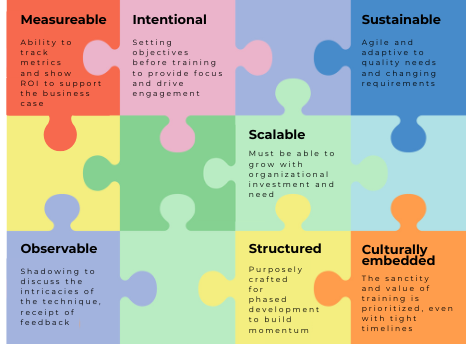
Fig 1. Michael’s core GxP principles for successful bioanalytical training.
Cathy: In the previous column on training, I referenced the key role that shadowing can play in the training process. Could you share some of your philosophies on what effective shadowing looks like?
Michael: Shadowing is most effective when it is intentional and structured — not observational by chance. High‑performing laboratories design shadowing experiences with defined technical and quality objectives that align SOP expectations with real‑world execution.
Effective shadowing asks targeted, scorable questions such as:
- What specific techniques are being observed?
For example, sample extraction during a bioanalytical assay. - What variables should the trainee actively watch for?
Pipetting angle and speed, timing between steps, vortex consistency, or temperature control. - What quality or safety risks could arise at this step?
Cross‑contamination during sample handling, deviation from hold‑time limits, or inconsistent mixing leading to variability. - What questions should the trainee be able to answer afterward?
Which steps are most sensitive to timing? Where does analyst technique most impact assay precision?
Providing a structured shadowing checklist transforms passive observation into active learning and supports harmonized quality practices across analysts and teams.
During shadowing, trainees should be expected to document:
- Differences between written SOPs and actual execution
E.g., informal sequencing of steps not explicitly described in the method. - Analyst‑to‑analyst technique variations
E.g., differences in mixing technique that may affect recovery. - Environmental-, timing- or equipment‑related factors not explicit in protocols
E.g., centrifuge availability driving workflow timing decisions.
This documentation serves as more than a training artifact — it becomes a practical tool for troubleshooting assay variability, supporting method transfers, informing deviation investigations and driving continuous improvement. By formalizing shadowing in this way, laboratories reinforce consistency at the bench while creating measurable indicators of technique proficiency and readiness.
Cathy: When we discuss shadowing and training, often we’re considering downstream workflows, such as the transfer of a validated method to a sample analysis team. How can we apply these recommended strategies earlier, such as during the method development stage, to boost the probability of long-term success?
Michael: Training should not begin only after an assay is declared “final.” Assay developers and method owners gain significant insight by observing downstream workflows early and collaborating with Quality and Operations teams to anticipate sources of variability before validation and transfer.
One effective strategy is to incorporate downstream simulation runs during assay development, designed to mirror real execution conditions. For example:
- Use the same tube types, dilution schemes and pipetting strategies planned for production
A method that performs well using low-retention tubes and slow, deliberate pipetting during development may behave very differently when executed at scale with standard consumables and higher throughput expectations. - Evaluate whether the assay tolerates realistic throughput conditions
Simulating back-to-back plate processing can reveal timing sensitivities, hold-time risks or fatigue-driven shortcuts that are not apparent in low-volume development work. - Identify steps where technique variability or ergonomic strain may become limiting
Extended pipetting at awkward angles, repetitive centrifuge loading or sustained, fine motor movements can introduce both variability and long-term injury risk — factors rarely captured in method text but highly relevant to routine execution.
Capturing these insights early enables:
- Clearer, more executable SOPs
Including technique-specific guidance where variability is most likely. - More targeted training during validation and sample analysis
Focusing effort on high-risk steps rather than evenly distributing attention. - Smoother inter-lab and inter-group transfers
Reducing rework driven by unspoken assumptions about technique or workflow.
By embedding technique standardization into assay development and not just downstream training, laboratories better align training, quality and operational efficiency. This proactive approach reduces retraining, minimizes avoidable variability and strengthens assay robustness across the full lifecycle.
Cathy: Finally, it’s important to consider the role of the lab team in implementation. How can the technical training team work together with senior analysts to enhance knowledge transfer and quality across the organization?
Michael: One of the most underutilized resources in laboratories is the experienced analyst. However, technical excellence alone does not automatically translate into teaching effectiveness. For train‑the‑trainer programs to succeed, organizations must be intentional not only about how analysts are trained to teach, but also who is selected for that role.
High‑performing laboratories define clear criteria when identifying senior analysts to participate: demonstrated technique consistency, adherence to SOPs, sound quality judgment, the ability to articulate the “why” behind their actions, and willingness/passion to upskill others. Selection should be based on observable behaviors and execution reliability, not tenure or personal preference alone.
A formal train‑the‑trainer program then equips selected senior analysts with the skills to:
- Observe technique objectively and consistently
Separating true technique gaps from individual working styles. - Provide corrective feedback constructively
Addressing variability without evoking defensiveness or introducing inconsistency. - Assess proficiency using defined criteria rather than personal style
Supporting harmonized expectations across analysts, teams and shifts. - Reinforce harmonized GxP, quality and safety principles
Ensuring expectations are transmitted consistently at the bench.
When thoughtfully implemented, this approach turns experienced analysts into force multipliers, extending training capacity, improving consistency and reducing dependence on a small number of trainers. It also supports career progression and knowledge continuity while helping ensure that technical and quality expectations are reinforced uniformly across the organization.
Cathy: Thanks for diving further into the field of technical training this quarter! We hope that these practical tips and design considerations will be translatable to a range of bioanalytical settings.
Michael: On a closing note, as bioanalytical science continues to evolve, so too must how we train the people executing it. By embedding intentional, technique-focused training throughout the assay lifecycle, laboratories can strengthen data quality, operational readiness and long-term scientific success.
Find Cathy’s full collection of columns here.
Disclaimer: the opinions expressed are solely those of the authors and do not express the views or opinions of their employers, Bioanalysis Zone or Taylor & Francis Group.
Our expert opinion collection provides you with in-depth articles written by authors from across the field of bioanalysis. Our expert opinions are perfect for those wanting a comprehensive, written review of a topic or looking for perspective pieces from our regular contributors.
See an article that catches your eye? Read any of our Expert Opinions for free.