Highlights from the 20th WRIB

The 20th WRIB conference, 13−17 April, 2026
The 20th Workshop on Recent Issues in Bioanalysis (WRIB) conference was held in Dallas (TX, USA), with close to 1,200 professionals representing pharma/biotech companies, CROs and multiple regulatory agencies convening to actively discuss the most current topics of interest in bioanalysis. The 20th WRIB included three Main Workshops and seven Specialized Workshops that together spanned 1 week to allow an exhaustive and thorough coverage of all major issues in bioanalysis of biomarkers, immunogenicity, gene therapy, cell therapy and vaccines.
The three Main Workshop days covered:
- Day 1: Ligand binding, cell-based and molecular assays
- Day 2: Regulators’ inputs and ‘Ask the Regulators’ Panel discussions
- Day 3: Mass spectrometry, chromatography and sample preparation
Browse our Editors’ talk highlights from the event below.
Disclaimer: This summary was written by Bioanalysis Zone and is the author’s opinion and understanding of what was presented/discussed during the meeting. It has been written independently of WRIB, as the only official document released by WRIB is the annual White Paper in Bioanalysis.
Editors’ highlights
Session: Immunogenicity (ADA) assays and regulatory expectations
Chair: Huaping Tang (GlaxoSmithKline; London, UK)
Speakers: Kelly Coble (Boehringer Ingelheim; Ingelheim am Rhein, Germany), Theingi Thway (Eisai; Tokyo, Japan), Roland Staack (Roche; Basel, Switzerland).
Summary: Kelly Coble opened the session with a summary of Boehringer’s approach to PK and ADA analysis of masked cytokines, reviewing (1) a clinical PK method and (2) a clinical ADA method. She highlighted that for clinical PK methods, a key challenge lies in adapting non-clinical IC-LC/MS PK methods to achieve the required assay sensitivities. Kelly presented a clinical PK reagent strategy, an IC-LC/MS PK workflow, and summarized clinical vs non-clinical assay sensitivities for receptor-masked prodrug, Fc-VHH masking domain, and cleaved active cytokine. The talk concluded with some lessons learned, key points being that aligning with regulators early on the 3 PK assays was critical to steering the prioritization of bioanalytical strategy, and having data available early during regulatory interactions is helpful.
Next, Theingi presented novel case studies, lessons learned, and recent advancements for challenges in immunogenicity methods. She used E7777 — an approved therapeutic recombinant fusion protein — as a case example to demonstrate the need for flexibility in cut-point determination rather than a one-size-fits-all approach of current guidance. E7777 is the first example in which high ADA titers did not negatively affect efficacy and safety: a clinical benefit despite still demonstrating robust immunogenicity.
Roland Staack completed the session with a discussion on how more quantitative ADA detection might change the ADA testing paradigm. He highlighted the assumptions that the 3-tiered approach is based on and suggested that there is a lack of understanding of what an ADA assay actually measures. He considered whether universally applicable guidelines for ADA assays are feasible and outlined a possible future ADA assay workflow where a 1-tier strategy could be used.
Key takeaway: The speakers shared excitement towards breaking away from traditional thinking around immunogenicity testing.
Session: Biomarker assay development, CDx, IVD and BAV
Chair: Sarah Hersey (Bristol Myers Squibb; NJ, USA)
Speakers: Brian Baker (Regeneron; NY, USA), Sarah Bond (Alnylam; MA, USA), Maciej Cabanski (Monte Rosa; MA, USA), Lingyi Zheng (Moderna; MA, USA).
Summary: Brian Baker kicked off this session by discussing in vitro diagnostics for gene therapies from a regulatory perspective. He provided an overview of companion diagnostics (CDx) and summarized the current FDA guidance on CDx development for gene therapies. Through case studies, Brian highlighted that CDx co-development may be required to identify the optimal patient population for a gene therapy trial, and that careful planning early on is crucial to mitigating risk to study start timelines.
Second speaker Sarah Bond focused on soluble biomarkers and their value in informing clinical development of investigational drugs. Sarah communicated the value of biomarkers in clinical studies in patient enrollment, safety and tolerability, and to showcase mechanism of action. Via three case studies, she further highlighted where soluble biomarkers can add value during drug development programs, and stated that close communication with the drug development program team to outline and revise biomarker testing strategy will enable success through clinical development.
The third speaker Maciej Cabanski discussed bioanalytical strategies for molecular glues — small molecule drugs that are increasingly popular in medicinal chemistry, allowing the field to expand into what were previously considered ‘undruggable’ targets. They work by binding to both a target protein and E3 ubiquitin ligase, which degrades the target protein. Maciej presented challenges and examples in identifying biomarkers and developing assays through two molecular glue programs: VAV1 and GSPT1.
Lingyi Zhang closed the session with a discussion on the choice of bioanalytical assays for vaccines and immunology. Bioanalytical assays in these areas require the establishment of a correlate of protection (CoP), which is a measurable immune marker statistically linked to a reduced risk of infection or disease. Lingyi used case studies to demonstrate successes and challenges in establishing CoPs and concluded the talk by explaining that CoP is often endpoint specific.
Session: How much is AI/ML really helping in discovery/regulated bioanalysis and IRA?
Chair: John Smeraglia (AstraZeneca; Cambridge, UK)
Speakers: Jean-Claude Marshall (Moderna), Jim Shen (Bristol Myers Squibb), Gary Jenkins (AbbVie; IL, USA), Ola Saad (Genentech; CA, USA).
Summary: This session was opened by Jean-Claude, who focused his talk on the use of AI for regulated bioanalytical testing. He showcased the many opportunities to apply AI in clinical development and the current regulatory guidance surrounding the use of AI. He discussed the practical implementation of AI into existing workflows, as well as some use cases for where it could be used in cutpoint analysis and graphing data. A key message from Jean-Claude was that learning comes before payoff.
Jim Shen took to the stage next to explore the transition towards agentic AI: autonomous systems that use large language models to pursue complex, multi-step goals with limited human intervention. These systems enhance decision-making processes by analyzing data and providing actionable insights and can even adapt to new situations through learned knowledge. This is substantially different from generative AI, which is used to create new content by learning patterns from large data sets. Jim emphasized the importance of recognizing the difference between these two AI types for an analytical environment and provided examples of where agentic AI can be incorporated in analytical labs.
Next to speak was Gary Jenkins, who asked the question: how much is AI/ML really helping in drug discovery and bioanalysis? He discussed the hype vs the reality of these systems, and emphasized that they are the tool rather than the destination. The bulk of Gary’s talk focused on utilizing in-house data and AI/ML for efficiency gains, with three key use examples.
The final talk of this session was delivered by Ola Saad and covered high-throughput MAPPs technology (MHC-associated peptide proteomics) — an MS-based technique used in preclinical drug development to identify peptides derived from biotherapeutics that are presented on MHC class II molecules — for enhancing immunogenicity risk assessment and PD monitoring. Ola showcased LC–MS-based immunopeptidomics as a powerful and versatile tool for insights at various stages of biotherapeutic development, and how highly optimized and automated MAPPs workflows ensure high sensitivity, robustness and technical reproducibility.
Key takeaway: The talks were measured and speakers readily acknowledged the current limitations of AI. Notably, speakers distanced the field from generative AI, which is the predominant mainstream conception of AI. Whilst there was little discussion of large language models, a key takeaway was that some AI technologies can be utilized effectively in the handling of very large datasets.
Enjoyed our Editor’s highlights? You can take a look at our previous conference reports here.
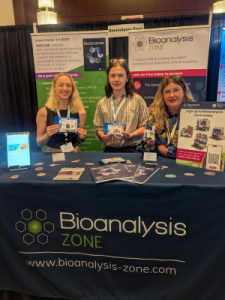
The Bioanalysis Journal and Zone team at the 20th WRIB. Left: Ellen Williams, Senior Digital Editor. Middle: Michael Bell, Managing Editor. Right: Sarah Mayes, Director of Advertising.