
A loaded tip

Solid-phase extraction (SPE) gets a glow up in Rob’s latest column—welcome to the world of within-tip SPE! It’s like taking the best of miniaturized tech and pairing it with the magic of 96-well automation. At first, the idea of bidirectional flow had Rob scratching his head, but turns out, it’s less about bands swinging wildly and more about a clever “switch on/switch off” process. Super clean, super efficient, and it makes the most of the sorbent capacity. With automation in the mix, this approach is set to shake up bioanalytical workflows in the best way possible. Exciting times are ahead!

Robert MacNeill
Scientific Director
Bristol Myers Squibb (NJ, USA)
Robert MacNeill received his Bachelor’s degree with Honors in Chemistry from Heriot Watt University then his MSc in Analytical Chemistry from the University of Huddersfield, both in the United Kingdom. Robert is also a Chartered Chemist and a Fellow of the Royal Society of Chemistry. With almost 30 years of experience in all aspects of quantitative bioanalytical LC–MS/MS method development, a regular speaker, patent-holder and contributor to the scientific literature, Robert is a recognized expert and innovator in the field.
In his current role, after spending over two decades in bioanalytical contract research, Robert is a scientific director at Bristol Myers Squibb, within regulated bioanalysis. Here, he continues to give mentorship in LC–MS/MS method development and validation, works to foster innovation and enjoys technical and witty writing.
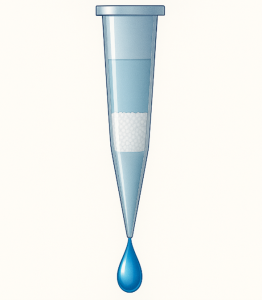
When within-tip solid-phase extraction (SPE) first came to my attention a few years ago, or perhaps indeed a couple of decades ago, I felt a combination of excitement along with a hint of chin-rubbing uncertainty. What a fabulous idea it was, bringing together miniaturized SPE in a super-convenient format along with the burgeoning but highly impressive 96-well automation of the time. This had the potential to be a wonderfully easy-to-use and definable means to perform optimized and superbly selective, high-recovery and squeaky-clean extraction from biological matrices. However, my most prominent pondering, amid all this good stuff, was to do with the bidirectional flow. Being raised in the solid-phase extraction arena on a purely top-loading agenda, where it’s just one same direction for the flow at each and every step, in many contexts things seemed easy to understand and anticipate on a band migratory basis as regards the dynamics on-sorbent.
So how about when it’s in two directions? Not only that, but multiple times for each step as appropriate? Furthermore, to really go with the flow, what can we infer from all this, in terms of the pivotal mechanics and characteristics of SPE?
It reminds me a little of when I learned about wave-particle duality in physical chemistry class back in my university days. As I carved into my granite slab notebook at the time, photons of light may be perceived to exist as both particles and as waves. The way to think about SPE is somewhat analogous in that it may be seen to operate both as a band migratory process as well as a “switch on/switch off” phenomenon. And yes, the favorite hashtag “wax on/wax off” has strong roots in this analogy too, like the roots of the Miyagi bonsai trees. So, in the experimental context, observations may be explained in the appropriate distinction. In this way, I believe the “switch on/switch off” hypothesis readily applies to within-tip SPE, easing our understanding and appreciation of what is going on therein.
All in all then, to aspirate and dispense the point again, it pays to regard within-tip SPE not with the band migratory dynamics of chromatography but rather as a process where a solute is either fully retained or fully unretained in a given step. Thereby, it allows a number of aspirations and dispensations to really define each procedural step within a method, but at the same time not taking liberties with the repetitions, thus maintaining the specific number within the definition. The accompanying automation will nail this aspect in any case.
Suffice to say that my bidirectional concerns were a little misdirected all those years ago. I was envisaging bands swinging dramatically back and forth on-sorbent, losing oodles of recovery and making optimization a very tough cookie. This is actually not reflective of reality in tip-based SPE. At this point, there are more than enough data, after all, to demonstrate beyond doubt that it is a truly functional and very beneficial approach.
All of this and not even mentioning the notable advantage of the sorbent capacity being fully swamped and utterly utilized in a within-tip scenario! That counts whether or not it is a solid monolithic format, packed particulate or dispersive.
In the big picture, it feels timely to proffer that the future bodes promisingly for within-tip SPE, for those willing to try it. It could almost certainly become pronounced in many bioanalytical workflows for multiple modalities, hand in hand with automation, naturally, and altogether becoming an intuitive and powerful combined entity. There is bound to be a lot of back and forth, granted, but let’s see the directions taken from this juncture.
Find Rob’s full collection of columns here.
Disclaimer: the opinions expressed are solely those of the authors and do not express the views or opinions of their employers, Bioanalysis Zone or Taylor & Francis Group.
Our expert opinion collection provides you with in-depth articles written by authors from across the field of bioanalysis. Our expert opinions are perfect for those wanting a comprehensive, written review of a topic or looking for perspective pieces from our regular contributors.
See an article that catches your eye? Read any of our Expert Opinions for free.